
Resin Paths in Kettering: Neat, Weed-Free Routes That Stay Put
Resin Paths in Kettering: weed-free, neat and built on a properly prepared base to last. Free survey with colour samples laid on site. Call for a quote.
Call Eco Resin Driveways on 01536 580137 to arrange a free survey, or use the Get a Free Quote button.

Resin paths Kettering homeowners ask us about are usually replacing something tired: a cracked concrete strip, wobbly slabs, or gravel that ends up on the carpet. At Eco Resin Driveways, we lay resin-bound surfaces that look tidy against Kettering’s red brick and ironstone frontages, with no weeds and no loose stones. The surface matters less than what lies underneath it, and that’s where most failures start. Our free survey includes colour samples laid against your own house, and an honest verdict on whether your existing path can stay or has to go. One price point to start with: a Kettering installer lists resin driveways at £150–£220 per m² all in (Rutland Driveways, October 2026). We explain where paths sit against that further down.
Understanding the Process
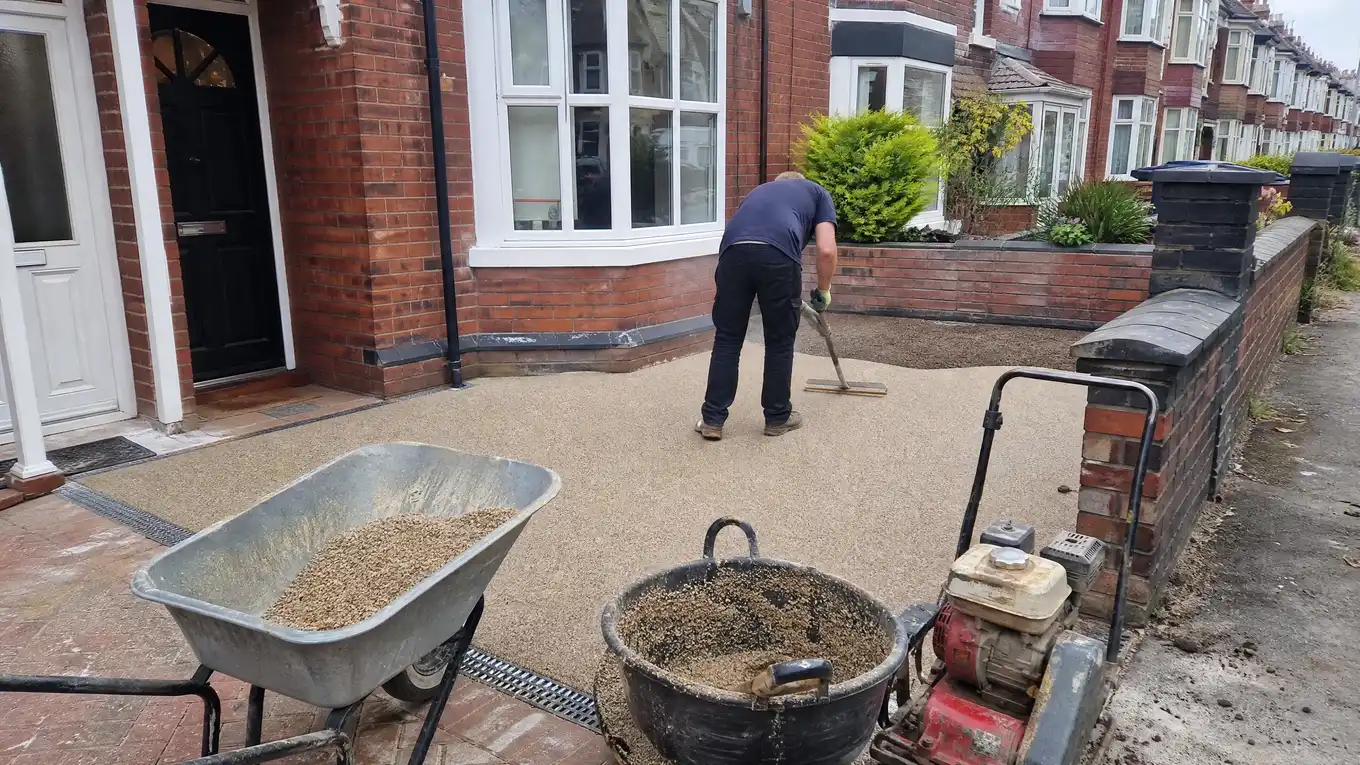
A resin-bound path is a mix of natural aggregate and clear resin, trowelled onto a firm base in one even layer. The resin coats every stone and holds it in place, but leaves gaps between them so water drains straight through. That’s why it feels smooth underfoot yet never goes slippery with standing puddles.
The layers beneath do the real work. A path needs a stable, well-compacted sub-base, usually with a porous asphalt or concrete layer on top, before any resin is mixed. BS 7533 guidance for pavement bases is a sensible benchmark for how the ground should be built up, and we follow the resin manufacturer’s installation specification for the system we’re using. Skip either and the surface will crack or ripple within a couple of winters.
Ground varies across the area too. Around Kettering it ranges from ironstone to clay, and new-build plots are often compacted subsoil under thin topsoil (Rutland Driveways, October 2026). Clay moves with the seasons, and thin topsoil hides poor compaction, so we dig test holes at the survey rather than guess.
Who Needs This Kind of Path?
Most people who call us fall into one of a few groups:
- Owners of 1930s and post-war homes in Kettering, Rothwell and Desborough whose old concrete or paving slabs have lifted, cracked or gone green.
- Households in Burton Latimer, Wellingborough and Corby with a side passage that floods or grows weeds between joints.
- New-build owners, including those at Hanwood Park, whose builder-laid paths have sunk or whose thin turf leaves a muddy trail to the front door.
- Families who need a smooth, level route for a pushchair, wheelchair or walking frame.
- Anyone whose gravel path keeps spreading onto the lawn or into the house.
Step by Step: From First Call to Finished Path
- Free survey. We measure up, check levels and drainage, probe the existing surface and lay colour samples against your brickwork or stone.
- Written quote. You get the price in writing, with the base work itemised so you can see exactly what you’re paying for.
- Dig-out or overlay. If the existing surface is sound, a resin overlay may work. If it’s failing, it comes out and the sub-base is rebuilt and compacted.
- Edging and levels. Edges are fixed and set to the right falls so water drains away from the house.
- Laying the resin. Aggregate and resin are mixed in small batches and trowelled to a consistent depth, then finished by hand.
- Clear-up and curing. We remove the waste and leave the area clean while the surface cures.
Types of Resin Paths
Most garden routes are a simple run from A to B, which we cover in the sections below. Where there’s a change of level, you’re into a more specialised job.
Resin Steps deal with the awkward bit where a path meets a rise at the front door, a sloping garden or a terraced bank. Each tread and riser needs forming, finishing and sealing to a consistent grip. Our dedicated page explains how that works, how edges are protected and what to expect on cost. If your route includes more than a couple of steps, start there.
Garden and Side Paths
A garden path has to cope with feet, wheelie bins, barrows and the odd bike. A side path between house and boundary fence has a harder life: it gets little sun, stays damp and collects leaf litter, so slabs go green and weeds take hold in the joints.
A resin-bound surface avoids all of that because there are no joints to colonise. A stiff brush and an occasional rinse will keep it clean. Side paths are often narrow, which means we work with compact mixing and careful edge control instead of big machines.
Colour choice matters here. Warm buff, golden or russet aggregates sit comfortably against the red brick found across Kettering, Burton Latimer and Rothwell, while browns and mixed gravels suit ironstone. We lay samples beside your actual walls at the survey, because colours look very different in a showroom than in daylight on your frontage.
If the path runs through a front garden to a drive, drainage matters. The Planning Portal says no planning permission is needed for a new or replacement driveway of any size that uses permeable surfacing, or drains to a lawn or border, but more than 5 m² of impermeable surface in a front garden that drains to the road does need permission (Planning Portal, Paving your front garden, 2026). A permeable resin build is designed with that in mind, in line with SuDS guidance.
Accessible Paths and Gentle Ramps
For anyone who uses a wheelchair, mobility scooter or walking frame, a path is not a cosmetic choice. Lifted slabs, gravel and uneven joints are the real obstacles between a person and their own front door.
Resin-bound surfaces are smooth, continuous and firm, with enough texture to give grip in wet weather. We can also build gentle ramps where a threshold or garden level change is blocking the way, forming a gradual rise instead of a step. The gradient needs careful setting out, with level landing areas and edges that keep wheels on the surface.
Accessibility needs vary, so we ask about them at the survey. Door thresholds, turning space at the entrance and bin storage all affect the design. If an occupational therapist has made recommendations, bring them along and we’ll build around them. Where a ramp sits close to the highway, or meets a pavement, we’ll also tell you if the council needs to be involved.
This type of job is often urgent and personal, so we keep it practical: a clear plan, a realistic timescale and no surprises on the day.
Edging That Stops Crumbling
Edges are where most paths begin to fail. A path with no restraint spreads outwards under load, and the resin at the margin breaks first, leaving ragged lines and loose stone. Edging must therefore be treated as part of the structure, not an afterthought.
We use block or steel edging, set into concrete haunching so it can’t shift. Steel gives a crisp, almost invisible line along lawns and borders. Block gives a more traditional look and works well beside brick walls. Costs vary, but national guidance puts block or steel edging at £30–£60 per linear metre (BestBuilders resin driveway cost guide, updated 22 August 2026). Because paths are long and narrow, edging forms a bigger share of the bill than it would on a patio.
Where a path meets a threshold, a drain or an existing wall, we form a clean joint rather than just butting the resin up and hoping. That detail is what stops water getting under the surface and causing trouble over winter.
What You’ll Gain
- Kerb appeal. A uniform, crisp surface that suits red brick and ironstone, without moss, weeds or stray gravel.
- Low upkeep. Sweep and rinse as needed. No weeding, re-gravelling or jet-washing slabs.
- Drainage. A permeable build lets water through, easing puddles and supporting permitted-development compliance in front gardens.
- Safe footing. No trip edges and a surface that is firm underfoot.
- Long life. A properly installed resin-bound surface on a sound base lasts 15–25 years (BestBuilders resin driveway cost guide, updated 22 August 2026).
- Colour retention. UV-stable resin costs £5–£12 more per m² and stops clear resin yellowing (BestBuilders, updated 22 August 2026). We recommend it for sunny paths.
Investment Guide
Published sources give a wide spread, so here are the three most useful ones side by side. A Kettering company lists resin or tarmac driveways at £100–£130 per m² (Divine Driveways Kettering, 2026). Another Kettering firm puts resin bound at £150–£220 per m² all in, covering dig-out, base, edging, surface and clear-up (Rutland Driveways, October 2026). National figures are lower, with resin driveways averaging £60–£95 per m² (MyJobQuote, updated 6 October 2026). The gap largely reflects what is included, particularly the base. For a short path, the fixed costs of setting up, mixing and edging weigh heavier per square metre than on a big drive.
What moves the price on your path:
- Condition of the base. A failing base that must be dug out and replaced adds £50–£80 per m² (BestBuilders, updated 22 August 2026).
- Edging length. See the per-metre range above.
- Resin type. UV-stable grades cost more, as noted.
- Access. A narrow side passage means more barrowing.
- Labour. Installer teams typically charge £300–£500 per day (MyJobQuote, updated 6 October 2026).
Quotes can vary a lot too. Installers’ prices for the same job can differ by 20–30% in the same area (MyBuilder, 2026), so compare what each quote includes.
Timescale: Resin is safe to walk on after 4–6 hours and ready for vehicles in 24–48 hours, depending on temperature (BestBuilders, updated 22 August 2026). Late spring or early autumn is usually the best time to lay it, as winter cold and rain can spoil the cure (MyJobQuote, updated 6 October 2026).
The survey: We measure the route, probe the existing surface, check falls and drainage, and lay colour samples against your frontage. If your property is in one of Kettering’s 26 conservation areas, which include the town centre, Barton Seagrave, Burton Latimer, Geddington and Rothwell (Rutland Driveways, October 2026), we’ll flag it early so you can check any local constraints. If your path leads to a drive that needs a new vehicle crossing, that falls under Highways Act 1980, section 184, and North Northamptonshire Council sets the fee, so confirm the current charge with them directly.
Ready to Replace a Tired Path?
Whether it’s a cracked side passage in Burton Latimer or a sunken garden route in Wellingborough, we’ll tell you plainly what the job needs and what it will cost, with sources shown. Call 01536 580137 or Get a Free Quote to book your free survey, colour samples included.


How It Works
From initial survey to completion — here’s what to expect when you work with us.
Free survey and samples
We measure, check what is under the current surface and lay colour samples against your brick or stone in daylight.
Written fixed price
You get one itemised price in writing: base, edging, drainage, resin and clear-up. No surprises on the day.
Base and edging
We dig out or repair the base, fit the edging and make sure water has somewhere to go.
Lay, trowel and cure
Resin and stone are mixed on site and hand-trowelled smooth. You can walk on it in hours and drive on it within two days.
Related Services
Explore our specialist Resin Paths in Kettering: Neat, Weed-Free Routes That Stay Put services.
Resin Path Cost in Kettering (2026)
Resin path cost in Kettering explained: sourced price per m², base and edging extras, and a worked example. A helpful guide from our Resin Paths specialists.
Read guide →Resin Steps
Resin Steps in Kettering: slip-resistant, weed-free and permeable, built on a proper base to lift your kerb appeal. Free home survey. Call for a quote.
View service →Frequently Asked Questions
Local published prices range from £100–£130 per m² (Divine Driveways Kettering, 2026) to £150–£220 per m² all in (Rutland Driveways, October 2026). Short, narrow paths tend to sit toward the upper end because edging and set-up costs are spread over less area. Base condition is the biggest variable, and we itemise it in writing.
Usually not. A permeable surface, or one that drains to a lawn or border, doesn't need permission (Planning Portal, Paving your front garden, 2026). Permission is needed for more than 5 m² of impermeable surface in a front garden that drains to the road. A resin-bound build is permeable, but we'll check your layout at the survey.
Sometimes. If the existing concrete or tarmac is sound, level and free-draining, an overlay may work. If it's cracked, sunken or moving, the problem will reflect through the new surface and the base must come out. We probe it at the survey and tell you honestly which applies.
A resin-bound path is safe to walk on in 4–6 hours and ready for vehicles in 24–48 hours, depending on temperature (BestBuilders, updated 22 August 2026). Cold or damp weather can slow curing, which is why we avoid laying in poor conditions.
Standard clear resin can yellow in strong sunlight, but UV-stable resin stops that and costs £5–£12 more per m² (BestBuilders, updated 22 August 2026). Weeds are rarely a problem on a properly laid surface because there are no joints to root in. Moss or windblown debris can settle on the top, but a brush clears it.
Get a Fixed Price for Your Resin Driveway
Tell us roughly how big the drive is and what is there now. We visit, bring colour samples, check the base and give you a written price.