
UV Stable Resin vs Non-UV in Kettering – Does the Difference Matter?
UV stable vs non-UV resin explained: why drives yellow, what the upgrade costs and when it matters. A plain guide to Resin Bound Driveways in Kettering.
Walk down any street in Kettering and you’ll see drives that looked sharp when they were laid and now look tired. With resin, the usual culprit is sunlight, not cracking. At Eco Resin Driveways, the first thing we explain to anyone comparing quotes is that UV stable resin and standard resin can look identical on day one and very different after a few summers. Here’s what separates them, what the upgrade costs and when it’s worth paying for.
What actually happens to resin in sunlight?
Non-UV resin reacts to sunlight over time and slowly takes on a yellow or amber tint. UV stable resin is formulated to resist that, so the binder stays clear and the stone colour you chose stays true. The change is mainly cosmetic, but on a front drive it’s the first thing visitors notice.
The yellowing doesn’t happen overnight, and it doesn’t hit every drive equally. A south-facing frontage in full sun will show it sooner than a shaded one. Light aggregates such as pale golds, silvers and creams show it most, because the amber cast sits on top of a bright surface. Darker blends hide it far better.
Bear in mind that UV stability protects the look of the surface, not the structure. Strength and drainage depend on the mix and the base underneath. The same guide notes that UV-stable clear resin stops yellowing (BestBuilders resin driveway cost guide, updated 22 August 2026), which is the whole point of the upgrade.
Is the upgrade worth the extra money?
For most homeowners, yes. Upgrading to UV-stable resin costs £5–£12 per m² (BestBuilders resin driveway cost guide, updated 22 August 2026). On a 40 m² drive, that works out at roughly £200–£480 extra, set against a typical all-in resin bound price of £150–£220 per m² (Rutland Driveways, Resin driveways in Kettering, October 2026).
Put another way, the upgrade is a small slice of the total. A drive that has yellowed can’t be spot-repaired, because a patch of fresh resin will never match the aged surface around it. Fixing it usually means a new surface layer.
Where might non-UV resin make sense? Possibly on a heavily shaded back path, or where the aggregate is dark and the budget is tight. Even then, we’d rather you made that decision knowingly than found out later.
Why a cheap quote often skips it
When two quotes for the same drive sit far apart, the gap usually comes from what’s left out. Installers’ prices for the same job can vary by 20–30% in the same area (MyBuilder resin driveway cost guide, 2026). Some of that is fair differences in overheads. Some of it is a standard resin where you assumed UV stable, or a thinner base where you assumed a proper one.
Before you accept any quote, ask three questions:
- Is the resin UV stable, and can I see that written on the quote?
- What is going under the surface, and how deep is it being dug?
- Is the build permeable?
That last point matters for the rules as well. No planning permission is needed for a new or replacement driveway of any size that uses permeable surfacing, or drains to a lawn or border (Planning Portal, Paving your front garden, 2026). Our Resin Bound Driveways page explains how the permeable layers and base work together, which is the part no resin chemistry can make up for.
Choosing a colour that stays looking right
Kettering is full of red brick and ironstone frontages, and the aggregate you choose should sit comfortably beside them. Warm browns, russets and mixed earthy blends tend to suit those walls. In the town’s conservation areas, of which there are 26, including Barton Seagrave, Burton Latimer, Geddington and Rothwell (Rutland Driveways, Resin driveways in Kettering, October 2026), a quieter natural tone usually looks right. Check with the council if your home sits in one.
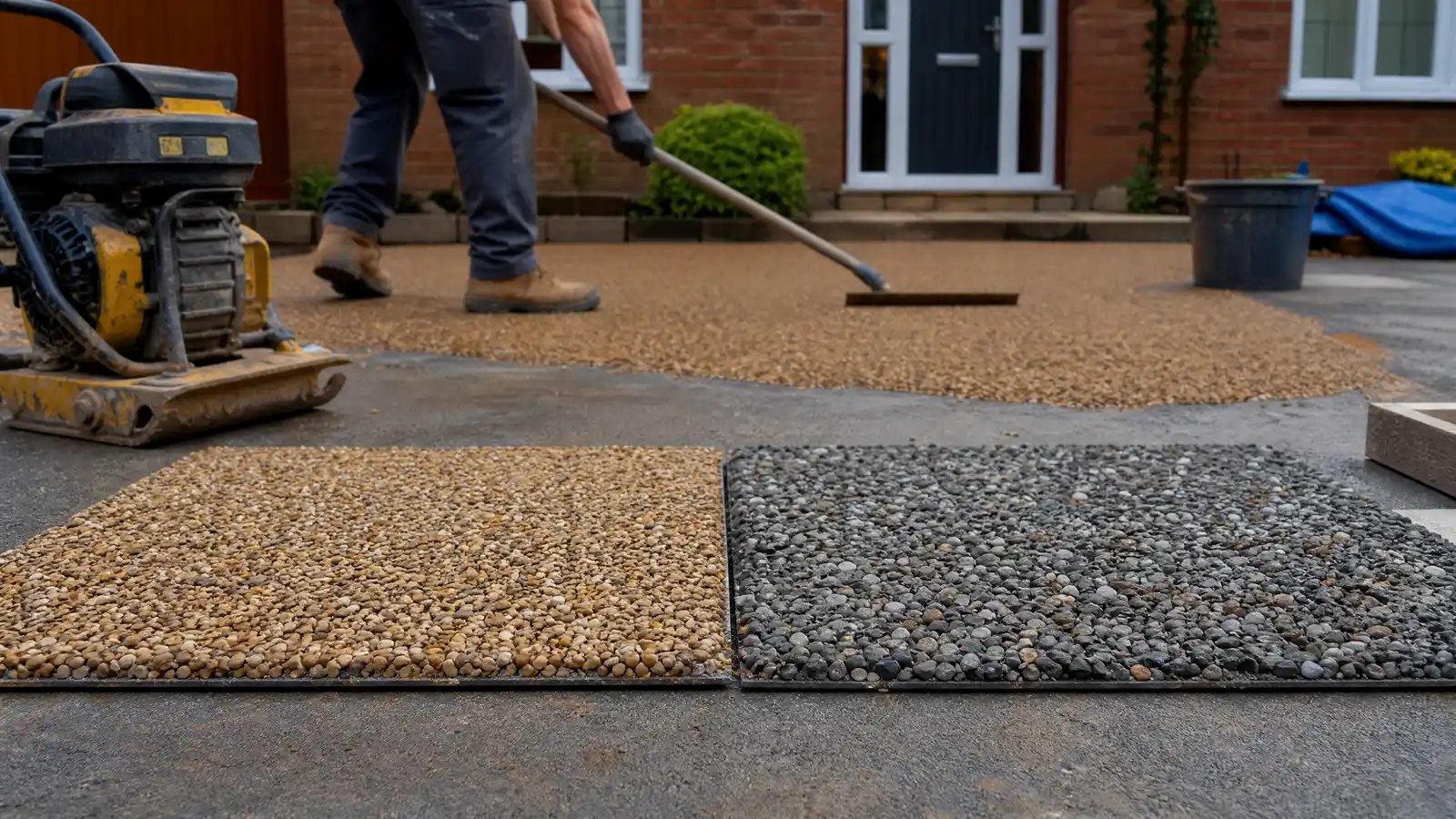
The same goes for newer estates such as Hanwood Park, where cleaner, lighter brick often pairs well with greys. Whichever you choose, we lay samples against your own frontage during the free survey, so you see the colour in your light rather than on a brochure.
Timing helps too. Late spring or early autumn is usually the best time to lay resin, because winter cold and rain can spoil the cure (MyJobQuote resin driveway cost guide, updated 6 October 2026).
Key takeaways
- Non-UV resin tends to yellow in sunlight, and light-coloured stone shows it most.
- UV-stable resin costs £5–£12 per m² more (BestBuilders, updated 22 August 2026), a small share of the overall bill.
- A yellowed surface can’t be patched invisibly, so the choice is best made before laying.
- UV stability protects colour only. The base underneath decides whether the drive cracks.
- Always get the resin type and base build written into the quote.
Next step
If you’re weighing up quotes, we’ll tell you plainly which resin is going down and what’s under it. Get a Free Quote or call 01536 580137 to arrange your free survey, with colour samples laid against your own frontage.


Frequently Asked Questions
It depends on the resin. Non-UV resin can slowly turn amber in sunlight, especially over light aggregates. UV-stable clear resin stops yellowing (BestBuilders resin driveway cost guide, updated 22 August 2026). Ask for it to be specified in writing so you know exactly what is going on your drive.
A properly installed resin bound driveway on a sound base lasts 15–25 years (BestBuilders resin driveway cost guide, updated 22 August 2026). The UV-stable binder helps the colour hold over that time, but the base build and correct installation conditions decide whether the surface lasts.
Not reliably by eye when it's new. If the surface has gone amber, especially where the sun hits it, it probably wasn't. Paperwork from the original installer is the best clue. If you can't find any, a survey will help you decide whether to refresh or replace.
Get a Fixed Price for Your Resin Driveway
Tell us roughly how big the drive is and what is there now. We visit, bring colour samples, check the base and give you a written price.