
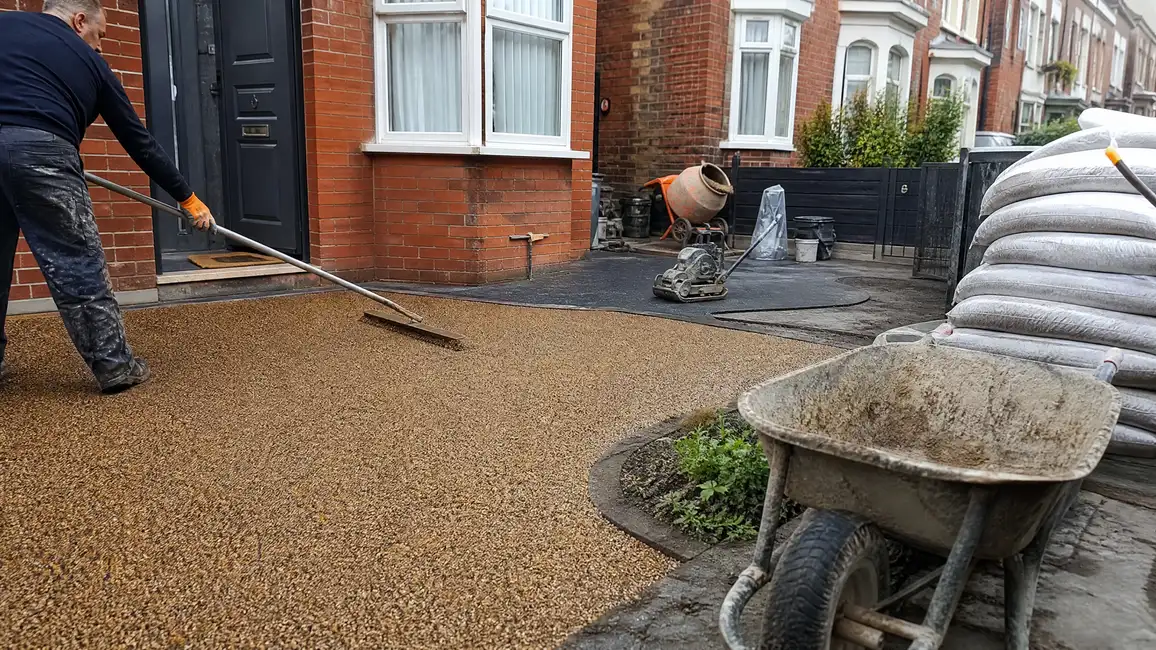
Resin Bonded Driveway in Kettering – A Clean Finish for a Tired Drive
Resin Bonded Driveways in Kettering: a tidy, hard-wearing finish that lifts kerb appeal with honest base advice and sourced prices. Call for a quote.
If your tarmac has cracked, your block paving has sunk or weeds have taken over the gravel, a resin bonded driveway in Kettering is one of the more affordable ways to bring the frontage back. Eco Resin Driveways lays a layer of resin and scatters stone into it, giving a textured, grippy surface for sound, well-drained bases.

Call 01536 580137 and we’ll arrange a free survey, laying colour samples against your own brickwork. National guides put resin bonded at £30–£50 per m² (BestBuilders resin driveway cost guide, updated 22 August 2026). The base underneath decides the real figure, and we’ll say plainly whether bonded suits your drive or resin bound would serve you better.
How the Surface Is Built
Resin is rolled onto a clean, sound base. Dried stone is then broadcast over it until the resin is fully covered. Once it has cured, we sweep off the surplus. What you get is a thin skin with the stone sitting on top.
That thinness is the key thing to understand. A bonded surface follows whatever is beneath it, so a dip, a crack or a spongy patch will show through. A good result depends on getting the base right first, following the manufacturer’s installation specification for the chosen resin system and the principles in BS 7533 guidance for pavement bases.
It is also textured and non-porous, so water runs across it rather than through it (MyBuilder resin driveway cost guide, 2026). We deal with that in the drainage section below.
Who It Suits
This option suits homeowners with an existing drive that is structurally fine but ugly: faded tarmac, stained concrete, or a firm base that just needs a fresh face. It also works for paths, patio edges and parking areas where the ground is stable.
We work across Kettering and in Corby, Wellingborough, Rothwell, Desborough and Burton Latimer. Ground around Kettering ranges from ironstone to clay, and new-build plots, including those on Hanwood Park and similar estates, are often compacted subsoil under thin topsoil (Rutland Driveways, Resin driveways in Kettering, October 2026). Those plots usually need a proper new base before any surface goes on.
Where Bonded Makes Sense
Bonded works best where the base is already sound and a lower-cost refresh is the sensible answer. A solid concrete drive with stable edges is a good example. So is tarmac that is firm and flat, with only surface wear and no cracking through the layers.
It also suits ground that slopes gently towards a lawn or border, where water can drain naturally. Grippy stone makes it a sensible choice on a modest incline.
It makes less sense on a drive with heave from tree roots, repeated cracking, or soft spots. There, the surface will only hide the problem for a season or two. In that case we’ll tell you the base must go, and quote for it separately so you can see what you’re paying for.
If you live in one of Kettering’s 26 conservation areas, including the town centre, Barton Seagrave, Burton Latimer, Geddington and Rothwell (Rutland Driveways, October 2026), check with the council before changing a frontage. A natural stone tone usually sits comfortably beside red brick and ironstone.
Drainage for a Non-Porous Surface
Because bonded resin does not let water through, the water has to go somewhere. Where it goes affects both how the drive performs and whether you need planning permission.
Under Planning Portal guidance on paving front gardens (2026), no permission is needed for a new or replacement drive of any size that uses permeable surfacing, or that drains to a lawn or border. Permission is needed to lay more than 5 m² of impermeable surface in a front garden that drains to the road.
Most bonded drives are therefore designed with a gentle fall towards a planted border or lawn, or with a drainage channel feeding a soakaway. Sustainable drainage (SuDS) guidance favours keeping rainwater on your own property rather than sending it to the street.
If your plot cannot drain sideways, say because it is tight, sloping towards the road or on heavy clay, we’ll tell you at the survey. In that case a permeable resin bound surface is often the cleaner answer. We won’t promise anything about planning permission that the layout can’t support.
Bound vs Bonded at a Glance
| Resin bonded | Resin bound | |
|---|---|---|
| Build | Stone scattered onto a resin layer | Stone mixed with resin and trowelled flat |
| Feel | Textured, rougher underfoot | Smooth, even |
| Water | Non-porous, so drainage must be planned | Porous and SuDS compliant |
| National price | £25–£45 per m² (MyBuilder, 2026) | £40–£70 per m² (MyBuilder, 2026) |
The Kettering picture is different. One local firm lists resin or tarmac drives at £100–£130 per m² (Divine Driveways Kettering, 2026), and another puts a resin bound drive at £150–£220 per m² all in (Rutland Driveways, October 2026). Those local figures include dig-out, base and edging, which national surfacing-only ranges don’t.
Bound costs more, but it is smoother, copes with a weaker-looking base better when properly built, and avoids the drainage question. Bonded is cheaper but fussier about what’s underneath it.
From Survey to Finished Surface
- Free survey. We look at the existing surface, test for movement, check falls and drainage, and lay colour samples against your frontage.
- Honest base verdict. We tell you whether an overlay will work or the base must be dug out and rebuilt.
- Preparation. Weeds, moss and contamination are removed, repairs are made, and edges are set with block or steel edging.
- Laying. Resin goes down in dry conditions, and stone is scattered to full coverage.
- Cure and clear-up. Surplus stone is swept off, and we leave the site tidy.
If you need a dropped kerb, the work must be approved under section 184 of the Highways Act 1980 through North Northamptonshire Council. We explain the application and check the current fee with you before we start.
What You’ll Gain
- Kerb appeal. A uniform, crisp finish instead of patched tarmac or gappy gravel.
- No weeds taking hold through a properly bonded, sound surface.
- Grip. The stone texture is reassuring on wet mornings.
- Lower outlay than bound, when the base is already good.
- Straight answers. You’ll know exactly what goes under the resin and why.
What It Costs and How Long It Takes
The surface is only part of the bill. These sourced figures help you judge a quote:
- Resin bonded: £30–£50 per m² (BestBuilders, updated 22 August 2026).
- Digging out and replacing a failing base: £50–£80 per m² (BestBuilders, updated 22 August 2026).
- Block or steel edging: £30–£60 per linear metre (BestBuilders, updated 22 August 2026).
- Installer day rates for labour: £300–£500 (MyJobQuote, updated 6 October 2026).
- Prices for the same job vary by 20–30% in one area (MyBuilder, 2026), so compare what each quote includes.
For timing, a 60 m² resin drive usually takes 2–5 days (MyJobQuote, updated 6 October 2026). Late spring and early autumn are usually the best times to lay, as winter cold and rain can spoil the cure (MyJobQuote, updated 6 October 2026).
Questions We Hear Most
How much does a resin bonded driveway cost in Kettering?
Nationally, resin bonded costs £30–£50 per m² (BestBuilders, updated 22 August 2026) and £25–£45 per m² for a standard finish (MyBuilder, 2026). Those are surfacing figures. A failing base that must be replaced adds £50–£80 per m² (BestBuilders). We give a written price after the free survey.
Do I need planning permission?
Not if the drive uses permeable surfacing or drains to a lawn or border (Planning Portal, 2026). Bonded resin is non-porous, so laying more than 5 m² at the front that drains to the road does need permission (Planning Portal, 2026). We design the drainage to a border or lawn where the plot allows, or recommend resin bound.
Can it go over my existing tarmac or concrete?
Sometimes. If the tarmac or concrete is sound, stable and drains properly, it can be cleaned, repaired and overlaid. If it is cracked, sunken or moving, the base must come out, because a thin bonded layer will reflect every fault. We’ll give you that verdict at the survey, not after the work has begun.
Do I need a dropped kerb?
If your drive crosses a pavement or verge, yes. Vehicle crossings are covered by section 184 of the Highways Act 1980, and North Northamptonshire Council must approve the work before it starts. The fee is set by the council, so we check the current figure with you at the survey and explain how the application works.
Which colour suits a red-brick or ironstone house?
Warm, natural tones usually look best: golden, buff and soft brown stone blends that pick up the orange-red of Kettering brick and the richer colour of ironstone. Cool greys can look flat against warm walls, though they suit slate roofs and modern frontages. We lay samples against your own frontage so you can judge in daylight.
Ready to Talk Through Your Drive?
If you’d like honest advice on whether bonded will work for your drive, call 01536 580137 and we’ll arrange your free survey, with colour samples laid against your own frontage. Get a Free Quote and you’ll know exactly what goes under the resin before anything is booked.


How It Works
From initial survey to completion — here’s what to expect when you work with us.
Free survey and samples
We measure, check what is under the current surface and lay colour samples against your brick or stone in daylight.
Written fixed price
You get one itemised price in writing: base, edging, drainage, resin and clear-up. No surprises on the day.
Base and edging
We dig out or repair the base, fit the edging and make sure water has somewhere to go.
Lay, trowel and cure
Resin and stone are mixed on site and hand-trowelled smooth. You can walk on it in hours and drive on it within two days.
Related Guides
Helpful articles to learn more about this service.
Get a Fixed Price for Your Resin Driveway
Tell us roughly how big the drive is and what is there now. We visit, bring colour samples, check the base and give you a written price.