
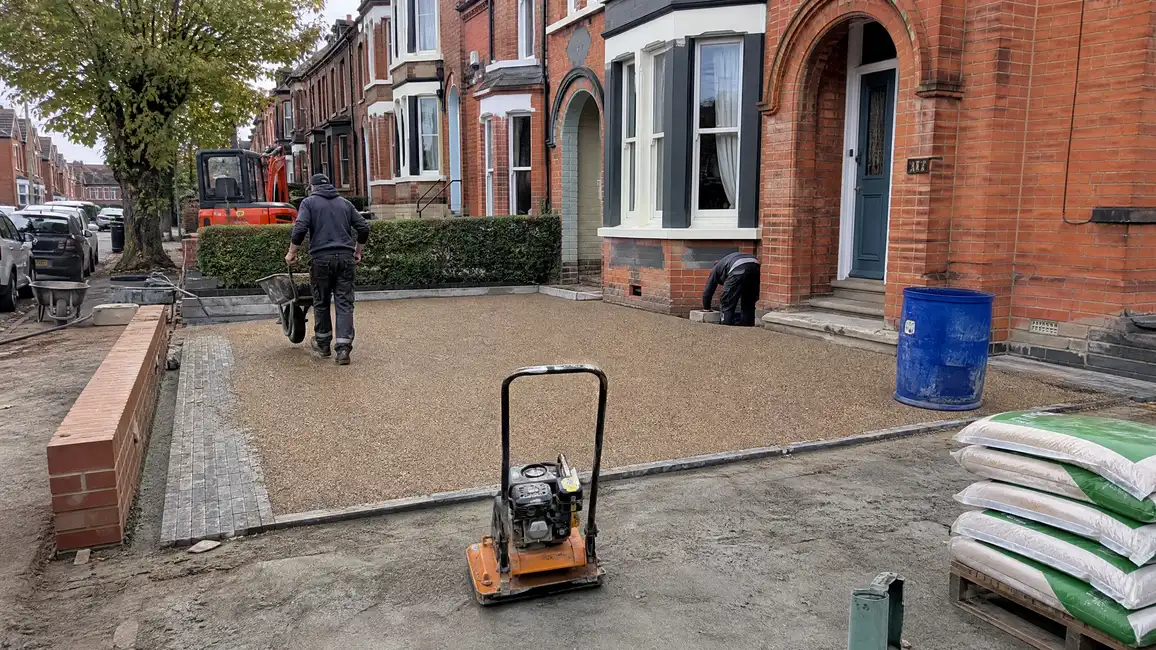
Resin Permeable Driveway in Kettering: Weed-Free, Well Drained and Within the Rules
Permeable Driveways in Kettering that keep your frontage compliant and well drained, with a properly built base and a free site survey. Call for a quote.
Call Eco Resin Driveways on 01536 580137 to arrange a free site survey, where we lay colour samples against your own frontage. Resin bound drives in Kettering typically cost £150-£220 per m² all in, covering dig-out, base, edging, surface and clear-up (Rutland Driveways, October 2026).

If your tarmac has cracked, your block paving has sunk or the gravel keeps migrating onto the pavement, a permeable driveway in Kettering is a tidy fix. Eco Resin Driveways lays resin bound surfaces on bases that let rainwater drain through rather than run into the road. That matters for the look of the house, and it matters for the rules. A drive that drains properly keeps most front gardens within permitted development. The part that decides whether it lasts is the base, so we explain exactly what goes under the resin.
How Water Gets Through the Surface
Resin bound means natural stone aggregate mixed with resin and trowelled into a layer a few centimetres thick. Mixed and laid correctly, it stays open-textured, so rain passes through the surface rather than sitting on it. Below that sits a porous stone base which holds water and releases it into the ground.
Both layers have to work. A permeable resin surface laid on a sealed, compacted base is permeable in name only. Water finds nowhere to go, pools at the edges and eventually pushes up under the resin.
That is why the build matters more than the finish. We follow the resin manufacturer’s installation specification for the surface, and the principles of BS 7533 guidance for pavement bases. Both are written around a base that is properly graded, compacted and free to drain.
Who This Suits
Most people who call us fall into one of these groups:
- Tired tarmac owners. Cracked, patched and fading to grey, with weeds in every split.
- Sunken block paving. Often a poor sub-base, sometimes tree roots, sometimes a drive that was never built for modern cars.
- Gravel fatigue. Stones in the hallway, ruts where the car sits, weeds that return every spring.
- New-build estates. Plots at places like Hanwood Park often sit on compacted subsoil under thin topsoil, so drainage needs thought from the start (Rutland Driveways, October 2026).
- Older streets. Red brick and ironstone frontages in Kettering, Rothwell, Desborough and Burton Latimer, where the drive should look right against the house.
We also work in Corby and Wellingborough, and on patios and paths where the same drainage logic applies.
Front Garden Paving Rules
Under the permitted development rules for paving front gardens in England, you do not need planning permission for a new or replacement driveway of any size if it uses permeable surfacing, or drains to a lawn or border (Planning Portal, Paving your front garden, 2026). Planning permission is needed to lay more than 5 m² of impermeable surface in a front garden that drains to the road (Planning Portal, 2026).
This is who it is for: anyone replacing a front drive, which covers most of our enquiries. The benefit is simple. You avoid a planning application, and you avoid a drive that floods the pavement in heavy rain.
A few things sit outside those rules. Kettering has 26 conservation areas, including the town centre, Barton Seagrave, Burton Latimer, Geddington and Rothwell (Rutland Driveways, October 2026). Extra controls can apply there, so check with the council before ordering anything. Listed buildings, flats and some new-build plots with restrictive covenants can also carry their own conditions.
We will not tell you a drive is exempt if it is not. At the survey we check how your site drains and what the paperwork says, then tell you plainly where you stand.
SuDS-Friendly Bases
Sustainable drainage (SuDS) guidance is built on one idea: deal with rain where it falls rather than sending it down the road. A SuDS compliant driveway has a surface that lets water in and a base that stores and releases it.
For homeowners, that means a build with an open-graded stone sub-base, sometimes a geotextile membrane to keep soil from clogging the stone, and falls that guide water towards soakaway ground. It suits anyone who wants a drive that passes the permeable test in the paving rules, and anyone whose street already struggles with surface water.
The benefit is a drive that handles heavy rain without puddles by the front door. Ground around Kettering ranges from ironstone to clay (Rutland Driveways, October 2026), and clay drains slowly. On clay, we may increase the depth of the stone layer so it can hold more water while it soaks away, or suggest a route for overflow to a border.
We would rather say this before the quote than after the first wet winter. Where the existing base is sound and already porous, an overlay can work. Where it is sealed, failing or holding water, it has to come out, and we tell you which at the survey.
Draining to a Lawn or Border
The other route through the paving rules is draining to a lawn or border. If rain falling on the drive is directed onto a planted or grassed area within your property, the drive is treated as compliant even where the surface itself is less permeable (Planning Portal, Paving your front garden, 2026).
This suits shorter drives, plots with a decent lawn or bed beside the frontage, and homes where the existing surface is staying put for now. It is also useful on tight Kettering terraces where a full-depth permeable build is awkward.
The practical side is gentle falls. We set the surface levels so water runs towards the planted area rather than the pavement or your neighbour’s boundary. A thin edging strip or a slightly lowered border does the rest.
The benefit is flexibility. You can keep a favourite hedge or flower bed as the drainage point. In many cases the approach is cheaper than digging deeper. You do need enough soft ground to take the water, and clay soils will need that area to be big enough. We walk the site with you and measure it rather than guessing.
From First Visit to Finished Drive
- Free survey. We look at levels, the existing surface and where water currently goes. We lay colour samples against your brickwork or ironstone so you choose in daylight.
- Written quote. It sets out whether we overlay or dig out, the edging, and the drainage plan.
- Dig-out and base. Old surface comes up where needed. The sub-base goes in layer by layer, compacted and set to falls.
- Edging. Block or steel edging holds the resin in and protects the edges from vehicle wheels.
- Laying the resin. Stone and resin are mixed on site and trowelled level in dry conditions.
- Hand-over. We clear up, explain aftercare and tell you when you can walk and drive on it.
Late spring and early autumn are usually the best times to lay resin, because winter cold and rain can spoil the cure (MyJobQuote, updated 6 October 2026).
What You Gain
- Kerb appeal. A clean, uniform surface that suits Kettering’s red brick and ironstone frontages. Warm buff, brown and natural stone mixes tend to sit well against both.
- No loose stone. Nothing to rake, nothing in the hallway.
- Fewer weeds. The surface is bound, and a sound base underneath keeps growth down.
- Confidence on drainage. The drive is built for the rules rather than hoping they do not apply.
- Longevity. A properly installed resin bound drive on a sound base lasts 15-25 years (BestBuilders, updated 22 August 2026).
Cost, Timescale and the Survey
Prices vary by firm and by what lies underneath. Resin bound in Kettering typically costs £150-£220 per m² all in (Rutland Driveways, October 2026), and most local drives of around 30-50 m² work out at roughly £4,500-£11,000 (Rutland Driveways, October 2026). Lower figures exist. One Kettering company lists resin or tarmac at £100-£130 per m² (Divine Driveways Kettering, 2026), and a national guide gives £60-£95 per m² (MyJobQuote, updated 6 October 2026). The gap usually comes down to what the price includes, so ask what is under the resin.
Installers’ prices for the same job can vary by 20-30% in the same area (MyBuilder, 2026). The things that move your figure are:
- Base condition. A failing base that must be dug out and replaced adds £50-£80 per m² (BestBuilders, updated 22 August 2026).
- Edging. Block or steel edging costs £30-£60 per linear metre (BestBuilders, updated 22 August 2026).
- Resin type. UV-stable resin costs £5-£12 per m² more and stops yellowing (BestBuilders, updated 22 August 2026).
- Drainage work. Soakaway ground, channel drains or extra stone depth on clay.
Resin bound is safe to walk on in 4-6 hours and ready for vehicles in 24-48 hours, depending on temperature (BestBuilders, updated 22 August 2026). A national guide puts a 60 m² drive at 2-5 days (MyJobQuote, updated 6 October 2026). The survey is free and carries no obligation.
Questions Homeowners Ask
Do I need planning permission for a permeable driveway in Kettering?
No, not for a new or replacement driveway of any size that uses permeable surfacing, or drains to a lawn or border (Planning Portal, 2026). Planning permission is needed to lay more than 5 m² of impermeable surface in a front garden that drains to the road. Conservation areas, listed buildings and flats can have different controls, so check first.
Can resin go over my existing tarmac or concrete?
Sometimes. If the existing surface is sound, level and not holding water, an overlay can work. But laying resin over a sealed surface may defeat the drainage, and a cracked or sunken base will show through. We give honest advice at the survey on whether an overlay will work or the base must go.
Do I need a dropped kerb, and who handles it?
If your drive crosses a pavement or verge, you need a vehicle crossing under section 184 of the Highways Act 1980. In our area, North Northamptonshire Council handles applications and sets the fee, so check its current charge before you budget. The work must be done by approved contractors. We can explain the process at the survey.
What is the difference between resin bound and resin bonded?
Resin bound mixes stone and resin together and trowels it to an even layer, giving a smooth, porous finish. Resin bonded spreads loose stone over a layer of resin, leaving a rougher, more textured surface. For drainage, resin bound is the usual choice. The surface is open-textured, so water passes through to the base.
Will a resin driveway fade or go yellow?
Cheaper resins can yellow in sunlight. UV-stable resin costs £5-£12 per m² more and stops yellowing (BestBuilders, updated 22 August 2026). On a pale or natural stone mix, we would recommend it. The stone itself holds its colour well, so most of the visible ageing comes from the resin.
Next Step
Whether your drive is cracked tarmac, sunken blocks or tired gravel, a short visit tells you what will work and what it should cost. We bring colour samples to lay against your frontage, check the drainage and give you a written price. Call 01536 580137 or Get a Free Quote and we will arrange a time that suits you.


How It Works
From initial survey to completion — here’s what to expect when you work with us.
Free survey and samples
We measure, check what is under the current surface and lay colour samples against your brick or stone in daylight.
Written fixed price
You get one itemised price in writing: base, edging, drainage, resin and clear-up. No surprises on the day.
Base and edging
We dig out or repair the base, fit the edging and make sure water has somewhere to go.
Lay, trowel and cure
Resin and stone are mixed on site and hand-trowelled smooth. You can walk on it in hours and drive on it within two days.
Related Guides
Helpful articles to learn more about this service.
Get a Fixed Price for Your Resin Driveway
Tell us roughly how big the drive is and what is there now. We visit, bring colour samples, check the base and give you a written price.